


Beneficial Nematodes Triple Blend Mix (Hb+Sc+Sf) - Grubs, Fleas, Fungus Gnats & More
TARGET PESTS
What Triple Blend Mix Targets
Because Triple Blend Mix contains all three species, its coverage is the combined pest list below, organized by which species (or species combination) handles each one.
- Moth larvae (caterpillars): armyworm, bagworm, cabbage looper, codling moth, cutworm, fall armyworm, garden webworm, hornworm, oriental fruit moth, tent caterpillar, tomato fruitworm, webworm
- Beetle larvae (grubs): asparagus beetle, blister beetle, chafer, Colorado potato beetle, cucumber beetle, Japanese beetle, May/June beetle, scarab, white grub (general)
- Weevil larvae (grubs): berry root, billbug, black vine, bluegrass, carrot, citrus, cranberry root, large pine, strawberry root
- Borers: general borers, corn, grape root, lesser cornstalk, mint root, peach tree, raspberry crown, squash vine
- Fly larvae & maggots: cabbage maggot, crane fly (leatherjacket), fungus gnat (Sciarid), gall midge, house & filth fly, humpbacked (phorid), leafminer, onion maggot, root maggot, shore fly
- Other soil and surface pests: ant queens, red fire ants, chinch bug larvae, flea larvae and pupae, termites, thrips pupae, ticks, root aphid, roaches

PRODUCT DESCRIPTION
Broad spectrum, full depth, extended season soil pest control.
Most soil pest problems don't stay in one place. Fleas ride the surface. Fungus gnat larvae and thrips pupae sit a few inches down. Grubs and beetle larvae feed deeper still, chewing through roots for weeks before anything shows up above ground. Treating just one of those zones, or guessing which single species matches your pest, leaves the other two untouched.
The Triple Blend Mix solves that by combining all three nematode species in one application: Steinernema carpocapsae (Sc) at the surface, Steinernema feltiae (Sf) in the shallow root zone, and Heterorhabditis bacteriophora (Hb) ranging deep. One mix, three depths, no guesswork about which pest is where.
How To Say It
Heterorhabditis bacteriophora: het-er-oh-rab-DY-tis bak-teer-ee-OFF-or-uh, or "Hb"
Steinernema carpocapsae: sty-ner-NEE-muh kar-poh-KAP-see, or "Sc"
Steinernema feltiae: sty-ner-NEE-muh FEL-tee-eye, or "Sf"
Three Species, Three Jobs
Instead of picking a single nematode and hoping it matches your pest, Triple Blend puts a specialist at every depth of the soil profile:
- Sc, the ambusher. Conserves energy by waiting at or just below the soil surface and striking the moment a host (a flea, a caterpillar migrating down to pupate) passes within reach.
- Sf, the shallow rover. Actively searches the upper few inches of soil or growing medium, the zone where fungus gnat larvae and thrips pupae actually develop.
- Hb, the deep cruiser. Ranges furthest into the soil profile, tracking host signals to reach grubs and beetle larvae feeding on roots well below where a surface-dwelling predator would ever cross paths with them.
Because each species works a different layer, they don't compete for the same hosts or interfere with each other in the mix. They simply divide the soil profile between them.
What Beneficial Nematodes Are
Nematodes are microscopic, unsegmented roundworms present in nearly any growing environment: translucent, slightly tapered, and too small to see without a microscope. The three species in Triple Blend are entomopathogenic biological control agents: rather than feeding on plant tissue the way plant-parasitic nematodes do, they hunt down insect pests, infect them, and let their symbiotic bacteria finish the job. That distinction, hunting pests instead of harming roots, is what makes these a soil treatment rather than a soil problem.

How Triple Blend Mix Works
All three species share the same core life cycle: eggs hatch into non-feeding juveniles, which molt into infective juveniles that hunt down a host. Once a juvenile locates a pest, it enters the body and releases symbiotic bacteria that kill the host within days. Juveniles feed on the cadaver, and the next generation of adults mates and lays eggs to restart the cycle. Where the three species are different is how and where they find a host.
When to Use Triple Blend Mix
Triple Blend Mix is the way to go when you're dealing with more than one pest, more than one soil depth, fluctuating temperatures, or you're simply not sure which single species matches what's in your soil. A seasonal rhythm covers all three zones at once:
- Early Spring (Mar–Apr): target overwintering pests once soil hits 46°F+
- Late Spring/Early Summer (May–Jun): interrupt first-generation pests before they cause a summer outbreak
- Mid-Summer (Jul–Aug): maintain control during peak activity
- Fall (Sep–Oct): treat before pests go dormant, to reduce next year's population
Most grubs, weevils, borers, and caterpillars run one generation per season, so a single well-timed application covers their vulnerable window. A handful of pests need repeat treatment instead, because their adults continuously reinvade and lay eggs on a rolling basis: ants, termites, fleas, fungus gnats, house & filth flies, humpbacked (phorid) flies, shore flies, and root aphids all call for reapplication roughly every 3–4 weeks rather than a single seasonal treatment.
Rounding Out Coverage Above the Soil
Triple Blend Mix handles everything happening at or below the soil line, from surface-active fleas down to root-feeding grubs. For pests that spend part of their life cycle above ground, pairing beneficial nematodes with other natural predators is a good way to disrupt the pest reproduction cycle before they reach the soil.
- Ladybugs (Hippodamia convergens): best known for aphids, but a genuine generalist predator that also feeds on thrips, mealybugs, and other soft-bodied insects on foliage.
- Green lacewing eggs/larvae (Chrysoperla rufilabris): larvae are generalist predators of aphids, thrips, mealybugs, whiteflies, and other soft-bodied pests on foliage.
- Orius insidiosus (Minute Pirate Bug) and Amblyseius cucumeris: target thrips once they've emerged onto foliage, while the Sf component of Triple Blend catches the pupal stage in the soil below.
- Trichogramma spp.: parasitize moth eggs on foliage before caterpillars ever reach the soil to pupate, where the Sc component would otherwise be their first line of defense.
- Hypoaspis miles (Stratiolaelaps scimitus): a soil-dwelling predator in the top layer of soil that feeds on fungus gnat larvae directly, adding a second line of defense alongside Sf's activity below.
Safe, Sustainable Pest Management
- Natural biological control with no synthetic pesticides
- Safe around people and pets when used as directed
- Safe for use on edible crops when used as directed, with no waiting period before harvest
- Fits seamlessly into existing IPM programs
- Requires no protective equipment
INTRODUCTION RATES / INTRODUCTION SITES
Introduction Sites
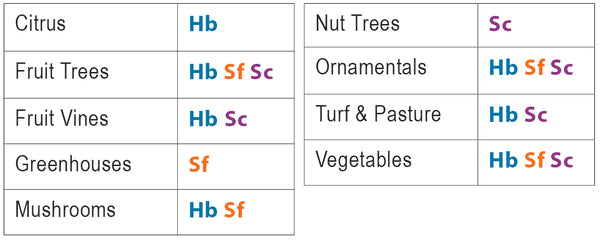
Beneficial nematodes can be used indoors, outdoors, or anywhere developing pests exist: gardens, greenhouses, indoor grows, houseplants, lawns, orchards, vineyards, and more.
Application Rates
These are general starting points. Actual application should be adjusted based on pest species, plant type, and infestation severity. Monitor pest and predator populations regularly to gauge how well the program is working.
| Application | Rate |
|---|---|
| Preventative/Light Infestation | 5 million nematodes per 1,250 sq. ft. |
| Moderate/Heavy Infestation | 5 million nematodes per 250 sq. ft. |
Soil Temperature Range
Apply when soil is above 46°F. Nematodes slow down in cooler soil but aren't harmed, and work best from about 55–86°F.
| Species | Minimum threshold (low activity) |
Optimum range (high activity) |
Upper practical limit (low activity) |
|---|---|---|---|
| Sf | ~46°F / 8°C | 57–79°F / 14–26°C | ~88°F / 31°C |
| Sc | ~57°F / 14°C | 66–88°F / 19–31°C | ~93°F / 34°C |
| Hb | ~61°F / 16°C | 66–91°F / 19–33°C | ~95°F / 35°C |
Combined, the blend tolerates soil temperatures from roughly 46°F to 95°F (8°C–35°C), giving usable coverage across a wider seasonal range than a single species alone. All three species need consistently moist soil to move and hunt.
CROPS
APPLICATION
How to Apply Triple Blend Mix
Apply indoors any time. Outdoors, stick to early morning, late evening, or a cloudy day; direct sunlight and UV rays kill nematodes. Wet the soil before and after application, and keep it damp for at least two weeks so all three species can move into position.
- Prepare the Soil: Water the treatment area first. Nematodes move through water, so dry soil stops all three species from reaching their targets, whether that's grubs feeding below the surface, fungus gnat larvae in the shallow zone, or fleas active right at it.
- Mix the Solution: Combine the blend with water between 59°F and 69°F. Water volume depends on treatment area size and infestation severity. Use the mixed solution within 1–2 hours; it stays viable up to 6 hours, but weakens the longer it sits.
- Apply to the Soil: Distribute the mixed solution evenly with a watering can, pump sprayer, hose-end sprayer, or irrigation system, whichever you already have on hand. Full, even coverage isn't necessary, since nematodes move through the soil on their own from there.
- Keep the Area Moist: Water lightly right after application, then maintain consistent soil moisture for two weeks. Avoid heavy watering that causes runoff, since that can wash nematodes out of the treatment zone before they reach any of the three soil layers.
Watering Can or Pump Sprayer
- Moisten the soil beforehand to avoid runoff and improve habitat.
- Mix 5 million nematodes with 1–5 gallons of water (59–69°F) to cover the desired area, diluting as needed for coverage.
- Water the treated area immediately after application and keep soil moist for two weeks.
Hose-End Sprayer
Use room-temperature water and let the nematode powder sit for 15 minutes to fully dissolve before spraying. Remove any screen filter first. Keep pressure at or below 72 PSI and use a nozzle 0.8 mm or larger.
| 5 million | Add all nematodes to the reservoir, fill to the 5 gallon mark. Spray until empty. |
| 10 million | Add all nematodes to the reservoir, fill to the 10 gallon mark. Spray until empty. |
| 25 million | Divide in half. Fill reservoir to the 15-gallon mark, mix in one half, spray until empty. Repeat twice. |
| 50 million | Divide into thirds. Fill reservoir to the 15-gallon mark, mix in one third, spray until empty. Repeat three times. |
Other Hose-End Sprayers (dial-style)
Use room-temperature water and let the nematode powder sit for 15 minutes to fully dissolve before spraying. Remove any screen filter first.
| Package Size | Preventative/Light | Moderate/Heavy |
|---|---|---|
| 5 million | 4 oz | 8 oz |
| 10 million | 4 oz | 8 oz |
| 25 million | 1.5 oz | 8 oz |
| 50 million | 4 tsp | 5 oz |

PRO TIPS / CHEMICAL COMPATIBILITY
Pro Tips
- Release indoors at any time, or outdoors in the morning, evening, or on a cloudy day. Nematodes are vulnerable to UV light.
- Water the soil before application and keep the surface moist for two weeks after.
- Apply when soil is above 46°F; nematodes work best from about 55–86°F. If soil is warmer than 86°F, water with at least 0.1 inch before and after application.
- Use the mixed solution within 1–2 hours of activation.
- Identify the pest first; the Target Pests chart shows which species covers each one.
- Pesticides, wetting agents, and spreader-stickers can harm beneficial nematodes' survival. Broad-spectrum and systemic insecticides are toxic to them.
Chemical Compatibility
Some chemicals, including pesticides and fertilizers, can harm or even eliminate beneficial nematodes, reducing their effectiveness as natural pest controllers. To protect your nematodes, it's essential to check chemical compatibility before applying it to your soil.
To make it easier, we've created a detailed list of chemicals that work safely with beneficial nematodes, ensuring your garden stays healthy.

STORAGE
Before Activation
Triple Blend arrives in a bubble mailer with an ice pack. If your order includes other items or totals over $200, it ships in a free cooler in a 12×12×12 box. It's normal for the ice pack to have melted and feel warm on arrival; the product remains effective to use. If you're not applying right away, refrigerate the unopened package at 36–45°F in a dark place for no more than 30 days. Do not freeze.
After Activation
Apply the mixed solution within 1–2 hours. Nematodes stay viable up to 6 hours after mixing, but they sink and start to drown, so they weaken the longer they sit.
FAQs
Why buy Triple Blend instead of a single species?
Because Sc, Sf, and Hb each work a different depth of the soil profile, and at different temperature ranges. Combining all three means one application covers surface-active pests, shallow-soil pests, and deep-feeding grubs at once.
Can all three species really be applied together without one interfering with another?
Yes. All three use the same water-based application method and soil moisture requirements, and they don't compete for the same hosts; each works a different layer of the soil profile.
Can I use Triple Blend alongside neem oil or insecticidal soap?
Yes, but timing matters. Apply nematodes a few days apart from any foliar spray, since some residue can affect nematode survival in the soil. The nematodes themselves pose no risk to your other treatments.
How often do I need to reapply?
It depends on the pest. Grubs, beetle larvae, weevils, borers, and most caterpillars run one generation per season, so a single well-timed application usually covers the vulnerable window. Ants, termites, fleas, fungus gnats, and a few other continuously reinvading pests need reapplication roughly every 3–4 weeks instead.
Is Triple Blend safe around edible plants, pets, and kids?
Yes. All three species are a natural biological treatment with no synthetic chemicals, safe around people, pets, and kids when applied as directed, and safe on edible crops with no waiting period before harvest.
How long until I see results?
Triple Blend begins working immediately after application. It typically takes 5–7 days to see visible results through reduced pest populations.
Does this work in growing media besides soil?
Yes. All three species are effective in coco coir and peat moss, as long as the medium stays consistently moist.
I've heard nematodes can damage plants. Is that what this is?
No. That's a different, unrelated category: plant-parasitic nematodes (like root-knot nematodes) feed on roots and can genuinely harm a garden. The beneficial nematodes in the Triple Blend mix don't feed on plant tissue at all.
How do I know if a single species or combination is best?
Use these charts to narrow your search:
Beetle Larvae (Grubs)
| Pest | Species |
|---|---|
| Asparagus | Hb Sf Sc |
| Blister | Hb |
| Chafer | Hb+Sc |
| Colorado Potato | Hb Sf Sc |
| Cucumber | Hb Sf Sc |
| Flea | Hb+Sc |
| Japanese | Hb+Sc |
| May/June | Hb |
| Scarab | Hb |
| White Grub (General) | Hb Sf Sc |
Moth Larvae (Caterpillars)
| Pest | Species |
|---|---|
| Armyworm (General) | Hb Sf Sc |
| Bagworm (General) | Sc |
| Cabbage Looper | Sc |
| Codling | Hb Sf Sc |
| Cutworm (General) | Hb Sf Sc |
| Fall Armyworm | Hb+Sc |
| Garden Webworm | Hb Sf Sc |
| Hornworm (General) | Hb Sf Sc |
| Oriental Fruit Moth | Sc |
| Tent Caterpillar | Sc |
| Tomato Fruitworm | Hb+Sc |
| Webworm | Hb Sf Sc |
Borers (Tunneling Larvae)
| Pest | Species |
|---|---|
| Borers (General) | Hb Sf Sc |
| Corn | Hb+Sc |
| Grape Root | Hb+Sc |
| Lesser Cornstalk | Sf |
| Mint Root | Hb+Sf |
| Peach Tree | Hb+Sc |
| Raspberry Crown | Sf |
| Squash Vine | Hb+Sc |
Weevil Larvae (Grubs)
| Pest | Species |
|---|---|
| Berry Root | Hb+Sc |
| Billbug (General) | Hb Sf Sc |
| Black Vine | Hb+Sc |
| Bluegrass | Hb+Sc |
| Carrot | Sc |
| Citrus | Hb |
| Cranberry Root | Hb+Sc |
| Large Pine | Hb+Sc |
| Strawberry Root | Hb+Sc |
Fly Larvae & Maggots
| Pest | Species |
|---|---|
| Cabbage Maggot | Sf |
| Crane (Leather Jacket) | Hb Sf Sc |
| Fly Larvae (General) | Hb Sf Sc (monthly) |
| Fungus Gnat (Sciarid) | Sf (monthly) |
| Gall Midge | Sf |
| House & Filth | Hb Sf Sc (monthly) |
| Humpbacked (Phorid) | Sf (monthly) |
| Leafminer | Sf |
| Onion Maggot | Sf |
| Root Maggot | Sf |
| Shore Fly | Hb Sf Sc (monthly) |
Miscellaneous Larval Pests
| Pest | Species |
|---|---|
| Ant (Queen) | Hb Sf Sc (monthly) |
| Ant (Red Fire Ant) | Hb Sf Sc (monthly) |
| Chinch Bug Larvae | Sc |
| Flea Larvae & Pupae | Hb Sf Sc (monthly) |
| Termite | Hb+Sc |
| Thrips pupae | Sf |
| Ticks | Hb+Sf |
DISCLAIMER / SHIPPING POLICY
STORE POLICIES
Thank you for shopping with us! Before placing your order, please review our Shipping Policy and Refund and Return Policy. By completing your purchase, you agree to these terms.
We do not provide recommendations on pesticide use. Products are sold for home use only, not commercial use.
QUALITY GUARANTEE
If your beneficial insects or other perishable products are not viable when delivered, email info@naturesgoodguys.sbs within 48 hours of delivery with your order number and a description of the problem. Photos may be requested. Approved replacements ship on Wednesdays and Thursdays.
- Open your package right away and check for storage instructions. Some products need refrigeration, and improper storage voids the guarantee.
- Ice packs help moderate temperature in transit and are not expected to arrive frozen.
- Some insects need time at room temperature before they become active, and many are hard to see without magnification.
SHIPPING
- Processing: 1 to 3 business days. Orders placed by 12:00 pm Pacific may process the same day, but this is not guaranteed.
- Overnight: ships Monday to Thursday, and Friday for addresses with Saturday delivery, excluding holidays.
- Second Day: ships Monday to Wednesday, and Thursday for addresses with Saturday delivery.
- USPS: ships Monday to Friday.
- We do not ship to PO boxes.
Some products are harvested on set days, and we may hold shipments during extreme weather to protect product quality. We will contact you if your order is delayed significantly.
CHANGES AND CANCELLATIONS
Please contact us within 30 minutes of placing your order to change or cancel it.
RETURNS AND REPLACEMENTS
Beneficial insects and other perishable products cannot be returned; they are covered by the Quality Guarantee above. Unopened garden supplies and tools can be returned within 30 days. Full details are in our Refund and Return Policy.
Replacements are not available for an incorrect shipping address, storage or use instructions not followed, or packages left uncollected after delivery.